Vetting Building Contractors for Cape Town Renovations
A polished quote is not enough to assess a renovation contractor. Vetting building contractors in Cape Town means looking beyond price to relevant project experience, a clear written scope and a practical plan for handling approvals, permits, restoration and building work. Where approvals are needed, establish who is responsible for each step before work begins.
It’s reasonable to want clarity before committing to work that affects your home or premises. This guide explains how to assess a contractor’s experience, paperwork, project planning and approach to renovation or restoration, so you can make a considered decision. It also covers questions that clarify responsibilities, reveal gaps in a proposal and show how the work will be managed from preparation through completion.
Table of Contents
Is a building contractor required to register with the NHBRC in South Africa?
What insurance and warranties should a Cape Town building contractor have?
How can I compare building contractor quotes and rates in Cape Town
What are the risks of paying a building contractor upfront, and how should payments be staged?
Is a building contractor required to register with the NHBRC in South Africa?
Whether a contractor must register with the NHBRC cannot be decided from the word “renovation” alone. The key question is whether the contracted work falls within the NHBRC’s registration requirements. Distinguish new-home construction from alterations, repairs and restoration before treating registration as a deciding factor. A contractor’s job title does not define the work covered by an agreement.
Start by describing the project precisely. A new dwelling, a room extension and a repair to existing plasterwork are different scopes. Record the property type, proposed structural changes and work included in the quote. This helps clarify whether NHBRC registration is relevant to the specific contract, rather than assuming every building job has the same requirements.
Where registration applies, treat it as one part of contractor vetting, not proof of every capability. A registration record does not explain who prepares planning applications, manages permits or coordinates restoration work. Match the contractor’s stated role to the written scope. For example, a proposal for an extension should identify the work included and who handles each approval-related task.
A practical review can follow these steps:
Write down whether the project is new construction, an extension, an alteration or repair.
Compare that description with the NHBRC registration requirement relevant to the work.
Record the contractor’s registration details where registration applies, and connect them to the contracting business.
Keep the scope, responsibilities and approval tasks in the written agreement.
For a Cape Town restoration or renovation, this approach avoids treating registration as a universal pass or an automatic disqualification. Assess the project scope first, then consider registration alongside the contractor’s relevant experience, quote detail and approach to approvals. Clear documentation makes the decision easier to explain and reduces uncertainty about who is responsible for each part of the work.
What insurance and warranties should a Cape Town building contractor have?
Ask for written details of insurance and warranty arrangements before signing a renovation contract. The right cover depends on the project, site conditions and people involved. Do not treat a verbal assurance as a substitute for policy information or agreed terms. A roof repair and an internal painting job, for example, may involve different risks.
Clarify which insurance applies to the work and who it protects. Ask whether the contractor has public liability cover for accidental damage or injury involving third parties. If employees or subcontractors will work on site, establish how work-related injuries are covered. If materials will be stored at the property, ask whether they and the work in progress are insured. Request written evidence showing the insured business, relevant activities and any exclusions that affect your project.
A warranty should describe the work it covers, its duration, exclusions and the process for reporting a defect. Check that it applies to the specific work in your quote, rather than relying on a general promise. For instance, a warranty for plaster repairs should clarify whether it covers the repair itself, associated preparation or later damage caused by another issue. Record who is responsible for correcting any agreed defect.
Before accepting terms, use this practical sequence:
Match the insurance details to the contractor and the worksite.
Ask which risks are excluded, including damage to existing finishes or stored materials.
Read the warranty scope, duration, exclusions and claims procedure.
Put agreed cover and warranty terms in the contract, with the relevant documents attached.
Keep the quote, contract, insurance evidence, warranty and project correspondence together. If the scope changes, record how the change affects cover and warranty responsibilities before the additional work starts. For a Cape Town renovation, plan the work and its scope alongside these written protections, so the agreed responsibilities remain clear from preparation through completion.
Ask the contractor for written evidence showing which business and activities are insured, and clarify how work-related injuries to employees or subcontractors on site are covered. Check that the documents apply to your project and record the agreed coverage in the contract.
How can I compare building contractor quotes and rates in Cape Town
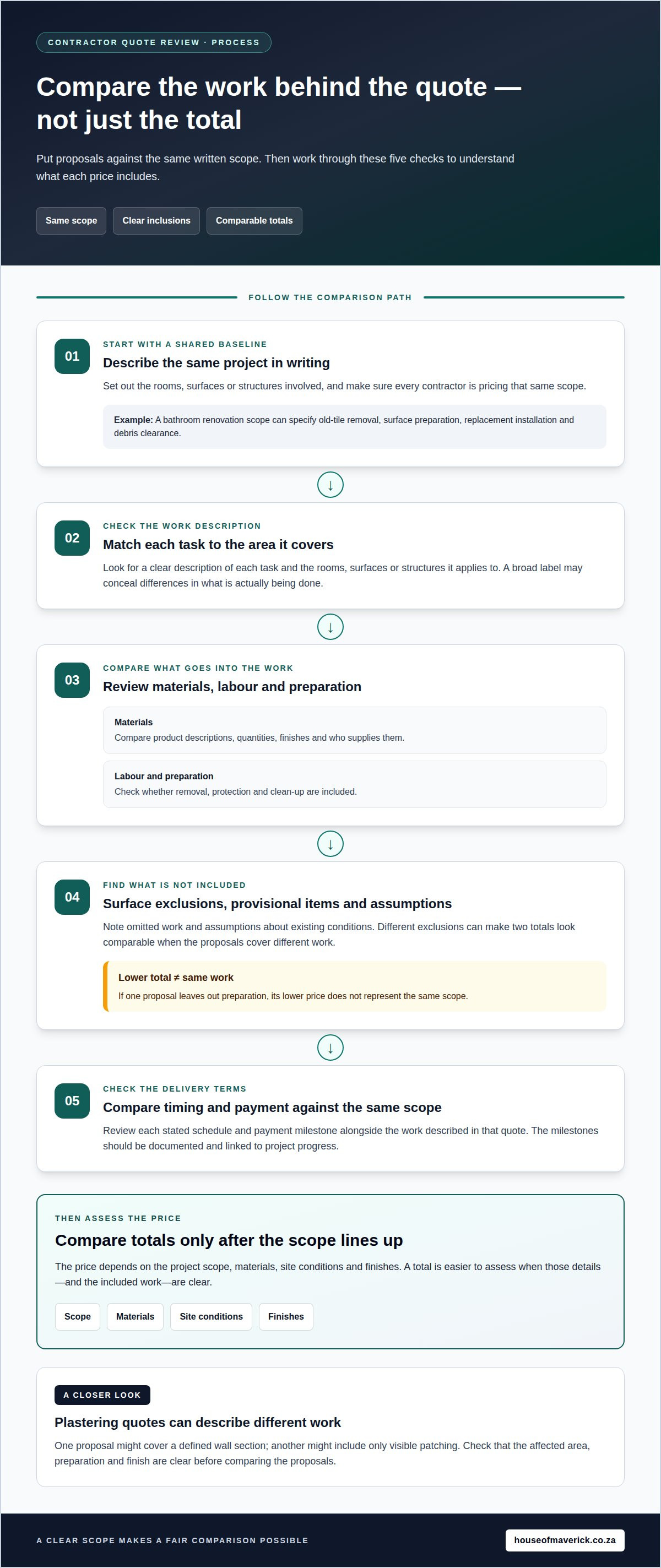
Compare quotes against the same written scope, not just the final totals. A bathroom renovation quote, for example, should say whether it includes removing old tiles, preparing surfaces, installing replacements and clearing debris. If one proposal excludes preparation, its lower total does not represent the same work. Aligning the scope makes differences easier to understand.
Work description: Match each task to the rooms, surfaces or structures involved.
Materials: Compare product descriptions, quantities, finishes and who supplies them.
Labour and preparation: Check whether removal, protection and clean-up are included.
Exclusions: Note omitted work, provisional items and assumptions about existing conditions.
Timing and payment: Compare the stated schedule and payment milestones against the same scope.
Two plastering quotes may, for example, make different assumptions about damaged areas. One might cover a defined wall section, while another includes only visible patching. The description should clarify the affected area, preparation and finish. Otherwise, the proposals cannot be compared fairly, and later changes may affect the agreed amount.
The price depends on the project scope, materials, site conditions and finishes, and is provided after a quote request. A change to the work, such as uncovering damaged plaster beneath paint, can also affect the final scope. Treat any proposed change as a written variation describing the additional task and its cost before it proceeds.
Choose the quote that clearly sets out deliverables and responsibilities, not simply the lowest total. Keep the accepted scope, exclusions, schedule and variations together as one project record. For Cape Town renovations, this makes it easier to track what the agreed amount covers and distinguish included work from later additions.
What are the risks of paying a building contractor upfront, and how should payments be staged?
Paying the full contract amount before work starts leaves little leverage if progress stalls or the scope changes. For example, a contractor might receive payment for plastering, then leave preparation or finishing incomplete. An advance can also make it harder to resolve a disagreement about materials, workmanship or remaining tasks. Agree payment stages in writing before the first transfer.
Link each payment to a clear project milestone, rather than a calendar date alone. A renovation schedule might set payments against site preparation, completion of specified building work and final handover. Describe what counts as completion at each stage. For example, “plastering complete” should identify the rooms or surfaces covered, not simply say that work is progressing.
A staged plan can set out:
The deposit, its purpose and any materials it covers.
The work that must be completed before each progress payment.
How changes to the scope affect the agreed payment schedule.
The final payment point, including agreed finishing work and handover items.
Keep invoices, proof of payment and written progress records together. Before releasing a stage payment, match the invoice to the agreed milestone and the work completed. If a variation adds a repair to the original scope, document its task, cost and payment timing separately. This gives both parties a shared record and helps prevent extra work being mistaken for an included task.
Avoid relying on verbal promises or unclear terms such as “payment as work proceeds”. The contract should state the amount due at each stage, the work it relates to and how any delay or dispute will be handled. If a contractor requests a large advance, ask what it covers and record the agreed protections before paying. A payment schedule should suit the project’s scope and material requirements, rather than leaving the full risk with one party.
Set out the project scope and milestones clearly before work begins. Discuss your renovation project to establish a practical basis for the work and its payment stages.
House of Maverick: Building and plasterwork
House of Maverick undertakes building and plasterwork for renovation projects that need sound construction and carefully finished surfaces. This is a practical option when your scope includes repairs, plastering or related building work, and you want these tasks handled as part of a clearly defined project. Other relevant services include Home Remodelling and Office Remodelling, Painting and Air-conditioning.
Set out the areas involved, the finish required and any related tasks before work begins. For example, a room renovation may need building work followed by plastering and painting. A clear scope helps align the work with the project plan and makes responsibilities easier to follow.
For a renovation discussion, contact House of Maverick.
Set a clear foundation for your renovation
Vetting building contractors in Cape Town is a practical step towards making your renovation easier to manage. Turn your plans and decisions into a written project scope, with the intended finish and responsibilities clearly set out. This gives everyone a shared point of reference as work moves forward and keeps the focus on the result you want.
House of Maverick can help with building and plasterwork, alongside related renovation services such as Office Remodelling, Painting and Air-conditioning. Discuss the work to establish which parts of your project fit these services and how they connect to your wider plans.
Take the next step at a pace that suits your project. Contact House of Maverick to discuss your renovation and the work you have in mind. A clear starting point can help turn your plans into a well-organised project.
Frequently Asked Questions
How can I verify a building contractor's registration and credentials in Cape Town?
Ask for the contractor’s registered business name and any NHBRC registration details relevant to the project. Match those details against the name on the quotation and proposed contract. For credentials, request copies of documents supporting claims about qualifications or trade expertise, then check that the names and business details correspond. Keep the documents with your project records, and distinguish evidence of registration from proof of experience or workmanship.
How do I check a contractor's references, past projects, and reputation in Cape Town?
Ask for examples of completed work similar to your project, such as a home alteration or commercial interior renovation. Look closely at the finish, how the work relates to the agreed scope, and whether the project is comparable in scale and type. Request references from previous clients and ask about communication, changes during the job and handover. Compare those accounts with the contractor’s portfolio rather than relying on photographs alone.
What red flags should I look for when vetting a building contractor in Cape Town?
Be cautious if the business name changes between correspondence, quotation and contract, or if the contractor avoids explaining who is responsible for specific tasks. Other warning signs include a quote that describes only a broad outcome, unexplained exclusions or refusal to record agreed changes. For example, a renovation proposal promising a finished room but omitting which rooms or tasks are included leaves room for disagreement. Ask for clear written terms before proceeding.
How can I check whether a contractor's workers are covered by COIDA and workplace safety requirements?
Ask for written details of how work-related injuries to employees and subcontractors on site are covered, and check that the documents apply to the contractor and your project. Put the agreed coverage in the contract.


Comments