Rising Damp Treatment in Cape Town: Diagnosis, Repairs and Next Steps
Could wall damage that looks like rising damp have another source? Salt marks, peeling paint and crumbling plaster can raise concern, but appearance alone can’t confirm what is happening behind the surface. A sound plan for rising damp treatment Cape Town properties need starts by investigating the moisture source, not by covering the damage and hoping it won’t return.
It’s understandable to want a clear answer before committing to repairs. Similar signs can result from moisture moving up through masonry, rain entering through the building, plumbing leaks or condensation. Each possibility calls for a different line of investigation and may lead to a different repair plan.
This guide explains which signs warrant investigation, how rising damp differs from other moisture problems, and how findings can shape repairs and finishing work. For Cape Town homes and commercial properties, House of Maverick can bring Waterproofing, Construction and Painting together where they fit the agreed scope. The aim is to plan the work around the identified issue, then restore affected surfaces with a practical, collaborative approach.
Table of Contents
Rising Damp in Cape Town: Signs That Deserve a Closer Look
Rising damp describes moisture moving upwards through porous masonry from the lower parts of a wall. Capillary action is the movement of water through tiny spaces in materials such as brick and mortar, much like liquid drawn into a sponge. A damp-proof course is intended to interrupt this movement; background on damp proofing methods explains the principle. In a property, visible marks are clues to investigate, not a diagnosis.
Which wall changes may point to rising damp?
Look for changes concentrated near the base of a wall, such as tide-mark staining, peeling paint, salt deposits, crumbling plaster or damaged skirting boards. A low, roughly continuous pattern may warrant closer investigation, particularly if it returns after the surface has been repaired. None of these signs confirms the cause on its own.
Before discussing rising damp treatment Cape Town, make a simple record:
Note which rooms and walls are affected, and how high the marks appear on each wall.
Record whether each wall is internal or external, and note changes to nearby finishes.
Write down when the signs appeared and whether they seem to change after rain, a leak or ventilation changes.
Photographs and these observations give useful context alongside the building’s condition and maintenance history.
Why damp marks alone do not settle the diagnosis
Moisture can reach a wall in different ways. Rain may enter through cracks or roof details, a plumbing leak can wet a localised area, and condensation may gather on cool surfaces in poorly ventilated spaces. These problems can also damage finishes, so a stain or patch cannot identify the source by itself.
Consider the pattern as well as the appearance. A patch that changes after rain, a mark near plumbing, or moisture across a broad surface may suggest a different line of investigation. These observations are not conclusive, but they help frame the discussion and prevent cosmetic repairs being chosen before the cause is understood.
Rising Damp Treatment in Cape Town Starts with Finding the Moisture Source
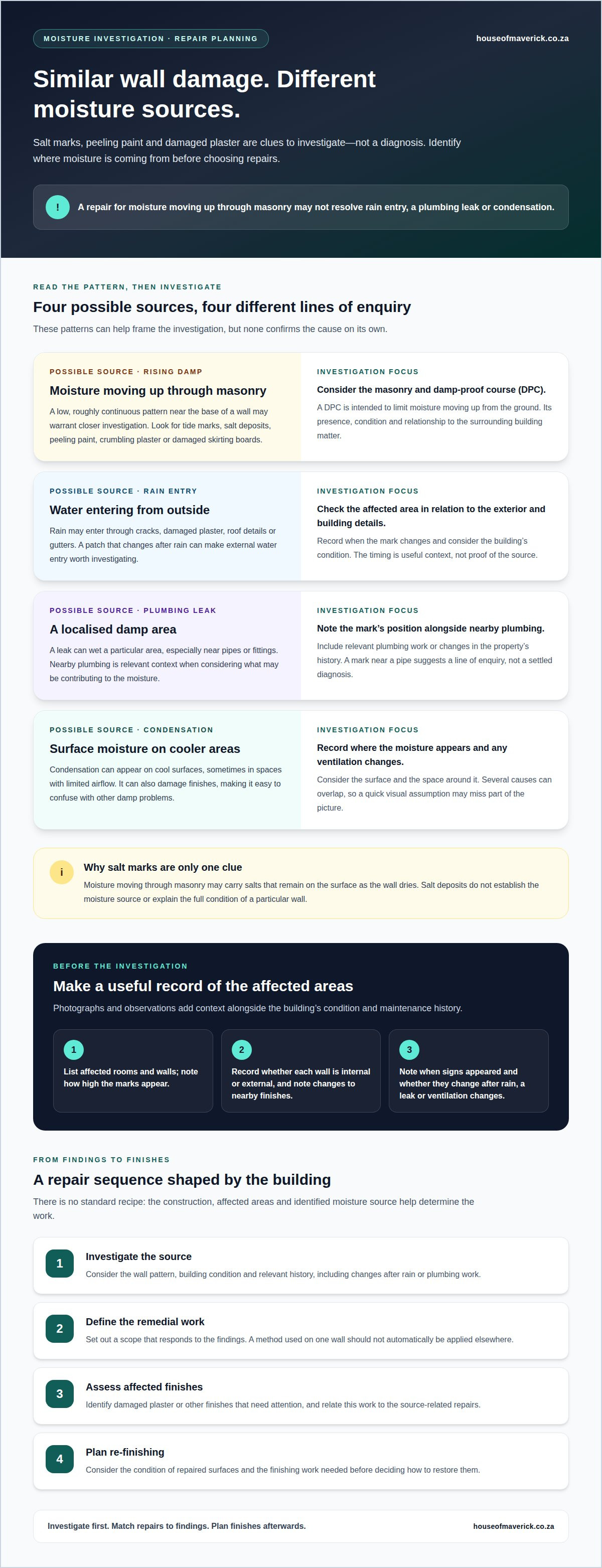
Wall damage can look similar even when moisture comes from different places. Effective remedial planning depends on identifying the source first. Work suited to moisture moving up from the ground may not resolve water entering through an exterior wall or a plumbing leak.
How capillary action can move moisture through masonry
Brick and mortar contain small pores. When masonry is in contact with moisture, capillary action can draw water through these tiny spaces, much as liquid travels through a sponge. A damp-proof course (DPC) is a barrier built into a wall to limit moisture moving up from the ground. Its presence, condition and relationship to the surrounding building all matter. It shouldn’t be assumed that every property has an effective barrier or that one repair will suit every wall.
As moisture moves through masonry, it may carry salts that remain on the surface as the wall dries. Salt deposits are one observation to consider, but they don’t establish the source or explain the full condition of a particular wall.
How rising damp differs from other damp problems
Rising damp is associated with moisture moving upwards from the ground through masonry. Penetrating moisture is more often linked to rain entering from outside, perhaps around damaged plaster, a roof detail or a gutter. A plumbing leak may create a localised damp area near pipes or fittings. Condensation tends to appear as surface moisture on cooler areas, sometimes in spaces with limited airflow.
These patterns are useful to consider, but they don’t settle the cause. For example, a patch that changes after rain may make external water entry worth investigating, while damp near plumbing suggests a different line of enquiry. Several causes can also overlap. A considered investigation is more useful than a quick visual assumption and helps shape rising damp treatment Cape Town properties may need.
Where findings point to connected repair and finishing work, coordinated property repair work can bring relevant tasks into one agreed scope.
A Practical Rising Damp Repair Sequence for Cape Town Properties
A repair plan should follow the findings, not a standard recipe. For rising damp treatment Cape Town properties may need, the building’s construction, affected areas and moisture source all help determine the work. Keeping investigation, repairs and finishing in the right order also makes the project scope clearer.
Investigate the source. Consider the wall pattern, the building’s condition and relevant history, including changes after rain or plumbing work. The aim is to understand what may be contributing to the moisture before selecting repairs.
Define the remedial work. Set out the work that responds to the findings. The appropriate scope can differ between properties, so a method used on one wall shouldn’t automatically be applied elsewhere.
Assess affected finishes. Identify damaged plaster or other finishes that need attention, and relate this work to the source-related repairs.
Plan re-finishing. Consider the condition of repaired surfaces and the finishing work needed before deciding how to restore them.
What happens before remedial work begins?
A useful project discussion starts with a clear record of the affected rooms and wall positions, the visible changes and when they appeared. Include relevant property context, such as nearby plumbing or recent work. These details help focus the investigation, connect the findings to a suitable repair scope and identify finishes that may need attention. The work can then be planned for the actual building, rather than assumed from a stain alone.
Why plasterwork and painting follow source-related repairs
Fresh plaster or paint can improve a damaged surface, but finishing alone may leave the underlying moisture source unresolved. Plan wall repairs and re-finishing in relation to the source-related work. Where the agreed scope calls for them, Construction can address building work, followed by Painting to restore affected surfaces. The required tasks depend on the findings and the condition of each surface.
For a coordinated approach to relevant repair and finishing work, discuss your property repair project with House of Maverick.
Plan Rising Damp Repairs with House of Maverick in Cape Town
Once the moisture issue has been investigated and the repair scope agreed, related work can be planned as one coordinated project. House of Maverick brings together Waterproofing, Construction, Painting and General Maintenance where relevant to the property. The team works collaboratively and pays close attention to detail, with the work guided by the agreed scope rather than treating visible marks as a diagnosis.
Residential and commercial repair planning
A Cape Town home, retail space or office each has its own access needs and daily routines. In an occupied home, consider which rooms are affected and how repair and finishing tasks fit around their use. In a shop or workplace, access to the affected wall and the sequence of work may also need attention. Established property recovery specialists such as TBC Restoration apply similar staged planning to residential and commercial projects to minimise disruption while addressing moisture damage thoroughly. These are planning considerations to discuss as part of the project scope.
House of Maverick can organise relevant work within the agreed scope, giving property owners a clearer view of how repairs and finishes relate. The specific tasks depend on the property and project findings.
Connect damp-related repairs with wider property maintenance
Wall repairs may sit alongside other maintenance needs identified during project planning. Where appropriate, General Maintenance can form part of a broader scope, while Construction and Painting address the affected building work and finishes. House of Maverick’s portfolio of completed projects gives property owners a way to view examples of the company’s work, while recognising that each project has its own requirements.
Good coordination keeps the agreed repair and finishing tasks connected, from planning through to completion. It also gives the team and property owner a shared understanding of what the project covers.
If you’re planning rising damp treatment Cape Town work, discuss the property and its repair needs with House of Maverick. Request a tailored project quote through the site’s Get a Quote option.
Take the Next Step Towards a Clear Repair Plan
A well-planned project gives you a practical way to move from uncertainty to agreed work. For rising damp treatment Cape Town properties need, start by noting your priorities, the areas affected and how the space is used. This gives the project discussion a useful focus and helps shape a scope around the property rather than assumptions.
Where the findings call for related work, Waterproofing, Construction, Painting and General Maintenance can be considered together within the agreed project scope. House of Maverick’s testimonials describe collaborative service, meticulous work and attention to detail, all useful qualities when repair and finishing tasks need to fit together.
Share your property details and the outcome you’re working towards. Discuss your Cape Town repair project and request a tailored quote through the Get a Quote option.
Frequently Asked Questions
How can I tell if a wall has rising damp?
You can look for possible clues, but appearance alone can’t confirm rising damp. Photograph the affected wall and note where the marks sit, whether nearby rooms show similar changes, and whether the wall is internal or external. Include relevant maintenance history, such as previous leak repairs or repainting. These details can make a property discussion more focused.
Can rising damp be mistaken for another damp problem?
Yes. Similar wall damage may relate to rain entering the building, a plumbing leak or condensation. Along with recording the affected area, note anything that may help explain when it appeared, such as a recent plumbing repair or changes after a storm. This context won’t diagnose the cause, but it can help focus the investigation before a repair scope is planned.
How is rising damp treated in a Cape Town property?
The work depends on the findings and the condition of the affected parts of the building. A suitable scope may coordinate moisture-related repairs with access to the wall and any required making-good or re-finishing. For rising damp treatment Cape Town properties need, avoid choosing a remedy from a photograph or applying the same approach to every building. The agreed plan should respond to the identified cause and set out related work.
Does peeling paint always mean rising damp?
No. Peeling paint doesn’t identify the source of moisture, and it may also relate to the condition of the surface or earlier finishing work. The position can provide context: paint peeling around a window or near a ceiling calls for a different investigation from damage concentrated at the base of a wall. Record the affected area before repainting or arranging repairs.
Should plaster be repaired before the damp source is addressed?
Plan plaster repairs in relation to the source-related work, rather than treating them as a stand-alone solution. Before agreeing the scope, identify which areas need repair and how adjacent finishes will be handled. The sequence for plaster and paint depends on the repair plan and wall condition. This helps coordinate finishing with the wider work instead of considering it in isolation.
Comments